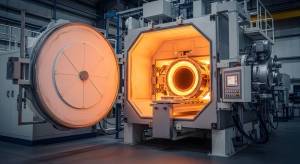

Vacuum furnaces play a vital role in numerous industrial processes, including heat treatment, brazing, sintering, and annealing of metals and ceramics. The unique environment within a vacuum furnace—characterised by extremely high temperatures and an absence of atmospheric gases—demands insulation materials that offer superior thermal performance, chemical stability, and longevity. Among the most effective solutions available is the foil faced carbon fibre insulation board a product we have handled many years with Kureha insulation board produced in Japan.
Vacuum furnaces operate by removing air and other gases from the chamber, creating a controlled environment that prevents oxidation and contamination during heat treatment processes. Temperatures can reach in excess of 2000°C, necessitating insulation that not only withstands such extremes but also maintains the integrity of the furnace and the quality of the processed materials.
Carbon fibre insulation boards are manufactured from high-purity carbon fibres, which are woven or pressed into rigid panels. These boards exhibit exceptional thermal stability, low thermal conductivity, and high resistance to chemical attack. Their structure ensures minimal outgassing, a critical factor in vacuum environments where contamination must be avoided.
The addition of a metallic foil facing enhances the performance of carbon fibre insulation boards in several ways. Firstly, the foil acts as a radiant heat barrier, reflecting thermal energy back into the furnace chamber and reducing heat loss. This improves energy efficiency and also ensures a more uniform temperature distribution within the furnace. Secondly, the foil provides a protective surface that reduces the risk of fibre shedding and particulate contamination. In a vacuum furnace, even microscopic particles can compromise the purity of the process, so this barrier is essential for maintaining a clean environment.
The carbon fibre insulation boards themselves can also come in different thickness and different material grades. For example the standard Kureha insulation R200 grade material can be supplied with a density of 0.13 g/cc or 0.16g/cc. There are cost difference and performance differences such as thermal conductivity implicit here. Beyond this there are further ‘ultra pure’ Kureha board grades which have extremely low ash content for processes which are ultra critical.
Although the boards are often foil coated, there can be applications where a special graphite coating is applied or other coverings such as carbon fabrics with and without graphite coatings are applied. The different finishes can help with such things as durability or gas permeability
A lot of furnace hot zones can be cylindrical in terms of their geometry and for these types the boards are usually cut in a ‘barrel stave’ style. It is also possible to have carbon fibre insulation cylinders produced for these furnaces but these cannot be foil faced due to the curvature and more often a graphite coating will be used to seal off the carbon fibre board material that the cylinder has been produced from.
The use of foil faced carbon fibre insulation boards in vacuum furnaces is driven by their unmatched thermal efficiency, contamination control, and durability. As industries continue to demand higher standards of quality and energy efficiency, these advanced insulation materials will remain an essential component in the design and operation of modern vacuum furnaces.
For more information on Kureha’s carbon fibre insulation board and cylinder products you can visit Kureha Carbon and PVDF – BAC – Carbon Fibre – SageZander and from there download the Kureha brochure. This will also give you an insight into Kureha’s other carbon products based on pitch carbon fibre in milled and chopped fibres; papers and mats.